Tupi or not Tupi


The Tupi people inhabited almost all of Brazil's coast when the Portuguese first arrived there. In 1500, their population was estimated at 1 million people, nearly the same population of Portugal at that time. They were divided into dozens of tribes, each tribe numbering from 300 to 2,000 people.  Despite the fact that they were a single ethnic group that spoke a common tongue, the Tupi were divided into several tribes which were constantly engaged in war with one another. Cannibalism was part of their ritual after a war. The warriors captured from other Tupi tribes were eaten as they believed they were absorbing their strength.
Tupi or not Tupi: that is the question
This phrase embodies the ideas of the Brazilian poet Oswald de Andrade in the Manifesto Antropófago (Cannibal Manifesto) published in 1928. The Manifesto played an important role in the modernism movement in Brazilian literature, for it argued that Brazil's history of "cannibalizing" other cultures was its greatest strength. Oswald de Andrade believed that literary cannibalism was a way for Brazil to assert itself against European post-colonial cultural domination. 
The Manifesto's iconic line is "Tupi or not Tupi: that is the question." The line is simultaneously a celebration of the Tupi, who practiced certain forms of ritual cannibalism (as detailed in the 16th century writings of André Thévet, Hans Staden, and Jean de Léry), and a metaphorical instance of cannibalism: it eats Shakespeare.

-- this post was edited from http://bit.ly/g0l7hM and http://bit.ly/gNBJji


The World's Longest River: the Nile or the Amazon?


For the last century the length of the Amazon and the Nile Rivers have been in a tight battle for title of world's longest river. The exact length of the two rivers varies over time and reputable sources disagree as to their actual length. The Nile River in Africa is reported to be anywhere from at 5,499km/3,437mi to 6,690km/4,180mi long. But there is no question as to which of the two great rivers carries the greater volume of water - the Amazon River.http://bit.ly/b1w3gY

Share

11 Fascinating New Species Found in the Amazon


Micro acariensis

The rainforests of the Amazon are one of the most amazing and unique ecosystems on the planet—the dense forests store between 90 and 140 billion tonnes of carbon and are home to one in 10 of every known species on earth.
As huge as these numbers seem, they largely underestimate the significance of the Amazon. More than any other place, the Amazon rainforest is home to untold numbers of undiscovered species. Between 1999 and 2009, more than 1,400 new species were found in the Amazon—more discoveries than all other regions of high biodiversity combined.

Full article: http://bit.ly/f0uZ04

Vitória Régia: Giant Waterlilly in the Amazon


These amazing plants produce gigantic leaves to cover as much surface area as they can, competing for precious light. Click the picture to see it in you tube. From the BBC. 


The Legend

In olden times, on the margins of the majestic Amazon river, the beautiful young women of an indian tribe gathered to sing and dream of life. They stayed for long hours staring at the beauty of the white moon, and the mystery of the stars, dreaming of being one of them.

As the aroma of the tropical night pulled at their dreams, the moon laid an intense light on the waters, making Naia, the youngest of the tribe and a dreamer, climb a tree to try to touch the moon. She didn't succeed. The next day, she and her friends climbed the distant hills to feel with their hands the smoothness of the moon, but again they failed. When they arrived there, the moon was so high that all of them returned to the longhouse feeling disappointed and sad. They believed that if they could touch the moon, or even the stars, they would transform themselves into one of them.

The following night, Naia left the longhouse hoping to fulfill her dream. She took the river trails to stare at the river's waters. There was the full moon, resplendent, immense, quietly reflecting its image on the water's surface. Naia, in her innocence, thought the moon had come to bathe itself in the river and allow her to touch it. Naia dove into the deep waters and there disappeared forever.

The moon, feeling pity for the young lost life, transformed Naia into a giant flower - the Vitória Régia - with an inebriating perfume and petals that spread on the water to receive the full light of the moon.

by Rosa Clement

The Rubber Tree


Natural Rubber Trees

Natural rubber comes from the Havea brasiliensis tree, which grows in tropical regions. They typically reach 20-30 metres in height on rubber plantations, and are able to produce commercial quantities of latex at about 7 years of age, depending on climate and location. Economical life span of a rubber tree is between 10 to 20 years, but may extend past 25 years in the hands of a skilled tapper and bark consumption.
It should be noted that latex is different to tree sap.

Dry Rubber Production

Tapping Rubber Trees

Havea trees are not tapped any more often than once per day, with 2 or 3 days being the norm. In countries such as Thailand, tapping usually takes place in the early hours of the morning, prior to dawn due to the high day time temperatures and the protective clothing worn to protect against snakes etc. Also flow rates are increased due to higher turgor pressures at these times.
A tapper uses a sharp hook shaped knife to shave a thin layer of fresh bark from the tree. This exposes the latex vesicles. The cut is typically done at 25-30° to the horizontal, as this exposes the maximum number of vesicles. The same incision is re-opened the next time (typically the next day) by shaving off a small amount of bark. Virgin bark is exposed first working around in panels. The same area may be exploited again after about 7 years.
AZoM - Metals, ceramics, polymers and composites - Tapping a rubber tree using angular, semi-spiral incisions.
Figure 1. Tapping a rubber tree using angular, semi-spiral incisions.
The thickness of the layer is important as too thick a slice will damage the tree and reduce its productivity and life, while too thin a slice will not produce sufficient latex. Bark is removed in a localised area for a period of time, and then a new area is tapped allowing the tree to repair itself.
The latex runs down and is collected in a cup. Each tree usually produces about half a cup of latex per day and is collected later in the day. Latex will flow for approximately 1 to 3 hours after which time the vesicles become plugged with coagulum.

Processing of Natural Rubber

Processing of natural rubber involves the addition of a dilute acid such as formic acid. The coagulated rubber is then rolled to remove excess water.
AZoM - Metals, ceramics, polymers and composites - Rolling the latex into thin sheets.
Figure 2. Rolling the latex into thin sheets.
Then a final rolling is performed using a textured roller and the resultant rubber sheet is dried. Following this, the rubber is ready for export of further processing. This type of natural rubber accounts for about 90% of natural rubber production.
AZoM - Metals, ceramics, polymers and composites - Final rolling of the latex sheets using a textured roller.
Figure 3. Final rolling of the latex sheets using a textured roller.
AZoM - Metals, ceramics, polymers and composites - The dried sheet of latex.
Figure 4. The dried sheet of latex.

Natural Rubber Production

Natural rubber is used in a pure form in some applications. In this case, the latex tapped from trees is concentrated using centriguges, removing water and proteinaceous materials. It is then preserved using a chemical such as ammonia.

Applications of Natural Rubber

The natural rubber is used for making products such as:
·         Glue
·         Tyres
·         Toys
·         Shoes
·         Condoms
·         Gloves
·         Catheters
·         Balloons
·         Some medical tubing
·         Elastic thread
At the end of a rubber trees’ useful life, the wood is used to make furniture and souvenirs.


Brazil's Climate Modellers Are Set to Go Global


Climate modellers in Brazil are getting ready to unleash a silicon god.


Named Tupã, after a native South American god of thunder, a Cray XT6 supercomputer is gradually coming to life at Brazil's Centre for Weather Forecast and Climate Studies in Cachoeira Paulista, northeast of São Paulo. By late November, when the machine is expected to be fully operational, it will have a peak processing speed of more than 244 teraflops, ranking it among the top 25 most powerful computers in the world. So great is Tupã's thirst for electricity that it will only run at 20% capacity until a new power source comes online in February 2011.

read full article: nature news


Share

Drought in the Amazon, Up Close and Personal

Choked by a long drought, rivers throughout the Amazon rainforest are at historically low levels.
You can learn a lot muddling around a forest in the middle of nowhere, but you also learn a lot once you’re back in the city catching up on your e-mail.

In the field we worried about why it was raining so little. Back in Iquitos, Peru, we discovered that our field work had coincided with the worst drought ever recorded in the Amazon basin. ... http://bit.ly/ga3c7s
Share

$50,000 Cash Reward for Anaconda Snake


anaconda

Eunectes murinus (derived from the Greek "Ευνήκτης" meaning "good swimmer" and the Latin "murinus" translated into "he who predates on mice") is a non-venomous boa species found in South America. It is the most massive of all known snake species. The term "anaconda" (without any further description) often refers to this species, though the term could also apply to several other members of the genus.
The Green Anaconda is one of the world's longest snakes, reaching more than 5 m (17 ft) long. Reports of anacondas 35–40 feet or even longer also exist but such claims need to be regarded with caution as no specimens of such lengths have ever been deposited in a museum and hard evidence is required. There is a $50,000 cash reward for anyone that can catch an anaconda 30 feet or longer, but the prize has not been claimed yet. Although the reticulated python is longer, the anaconda is the heaviest snake. The longest (and heaviest) scientifically recorded specimen was a female measuring 521 cm (18.1 ft) in length and weighing 97.5 kg (214 lbs).
The color pattern consists of olive green background overlaid with black blotches along the length of the body. The head is narrow compared to the body, usually with distinctive orange-yellow striping on either side. The eyes are set high on the head, allowing the snake to see out of the water while swimming without exposing its body. http://bit.ly/dsV7Db

Brazil Using Condoms to Protect Rainforest

Brazil has unrolled an ambitious plan to preserve vast areas of the Amazon rainforest by tapping its rubber trees to make sustainable condoms. Most "rubbers" are now made from cheaper synthetic materials, but officials of the Brazilian government—which buys 1 billion condoms a year—say the project will reduce its dependence on imports and give local people a livelihood dependent on trees which ensures they will battle deforestation.

The condoms will be the only ones in the world made from rubber harvested from a tropical forest. Similar schemes are under way to produce handbags and other items from rainforest rubber. If the condom project proves successful, Brazil's image as a "sexy country" could make the sustainable rubbers a hot-selling export, the Guardian notes.
Share

Big Fish in a Big River

pirarucu
giant catfish


The Amazon River is not only the greatest in the world, it is home to many other "extremes"  of the natural world. Have you ever seen a catfish? They're usually found in warm, slow moving waters of lakes and streams, and some people keep them as pets in aquariums. Catfish are pretty creepy looking fish with big flat heads and "whiskers" on either side of their heads (hence the name, catfish). Most catfish that we're familiar with here in the U.S. are anywhere from eight inches long to about five feet, weighing in at up to 60 pounds. But the catfish that live in the world's greatest river have all the room in the world to grow as big as nature will allow - they have been captured weighing over 200 pounds! One of the largest freshwater fish  in the world is found living in the waters of the Amazon River. Arapaima, also known locally as Pirarucu, Arapaima gigas are the largest, exclusively fresh water fish in the world. They have been found to reach a length of 15 ft/4m and can weigh up to 440lbs/200kg.http://bit.ly/b1w3gY

Brazil Using Condoms to Protect Rainforest

Brazil has unrolled an ambitious plan to preserve vast areas of the Amazon rainforest by tapping its rubber trees to make sustainable condoms. Most "rubbers" are now made from cheaper synthetic materials, but officials of the Brazilian government—which buys 1 billion condoms a year—say the project will reduce its dependence on imports and give local people a livelihood dependent on trees which ensures they will battle deforestation.

The condoms will be the only ones in the world made from rubber harvested from a tropical forest. Similar schemes are under way to produce handbags and other items from rainforest rubber. If the condom project proves successful, Brazil's image as a "sexy country" could make the sustainable rubbers a hot-selling export, the Guardian notes.

Share

Serbian Swimmer Conquers Amazon River

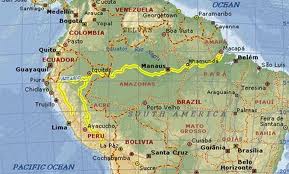
BELGRADE, Nov. 17(Xinhua) -- Serbian swimmer Darko Novovic has set a world record, swimming the length of the Amazon River - 5,450 kilometers - in just over 46 days, Reported Belgrade daily “24 Hours” Wednesday.
According to an interview with the Belgrade daily “24 Hours” on Wednesday, the 37-year-old Novovic began his feat on September 29 in Atalaya, Peru, near the source of the Amazon and swam for an average of 16 hours and a distance 188 kilometers daily. On November 13, Novovic finished by swimming 150 kilometers out into the Atlantic Ocean beyond Belem, Brazil, at the mouth of the Amazon River.
Novovic, who also successfully swam the English Channel, shattered the previous Amazon River record of 66 days held by Slovene Martin Strela.
“I was afraid of being attacked by bacteria which can blind you, or encounter any number of 'monsters,' said Novovic, who did come across a dead crocodile in the river. He said this 'fear' was a daily motivator to swim as quickly as possible.
Novovic said the swim was part of a fund-raising effort to build a pier around the church in the Montenegrin coastal town of Petrovac na Moru. He said he is already planning to tackle the Danube River from Belgrade to Schwarzwald at the river’s source in Germany next year. http://bit.ly/bRajUd

How did the Amazon River get to be so big?

The first reason has to do with its location - right at the equator. Around the "belt line" of the earth lies a warm, tropical zone where over 400 in/1016cm of rain fall every year. That averages out to more than an inch (3cm) of rain, everyday! A lot of water falls onto the land surrounding the river, what is called the "Amazon River drainage basin". A good way to understand what a drainage basin is to think of the whole northern half of the continent of South America as a shallow dish, or saucer. Whenever rain falls and lands anywhere in the river basin it all runs into the lowest place in the pan, which happens to be the Amazon River. The sheer volume of rain in the Amazon jungle, as well as the slope of the surrounding land, combine to create the enormous river known as the Amazon. http://bit.ly/b1w3gY