There are so many ways to say I love you...


Summer Look with Bamboo Rings


For details go to :http://www.etsy.com/view_listing.php?listing_id=40403097

The latest design

Finito!


This week I finished this really fund and bold necklace made with coconut caps and anahaw seeds. I will soon post it for sale -- but first I have to come up with a name as interesting as the necklace...

The Jatobá: Tree, Fruit, and Seed


Hymenaea courbaril
Jatobá
Also known in Brazil as jataí, farinheira, and imbiúva.
family: Fabaceae-Caesalpinioideae
English common names: Brazilian Cherry, South American Locust, Stinking Toe, Brazilian copal and various other names.

The name of the tree, Hymenaea, refers to the way it displays its leaves in matching pairs, for Hymen is the Greek god of marriage.


The jatobá is a canopy tree indigenous to the Amazon rain forest and tropical areas in Central America. It is a tree that grows to about 60ft and its wood is hard and heavy -- it is grown commercially for its high value timber. It produces a high-grade resin known as "copal" that is dug up from the base of the trunk and used in the making of varnish and for glazing pottery; the resin is aromatic and it is also used as incense.


The jatobá's large brown fruits contain a flour that is rich in minerals and calcium. It is food to animals and humans. Its resin, leaves, and seeds are employed medicinally in the treatment of respiratory illnesses. The bark is this Amazon tree has a delicate spicy flavor and is a popular energy drink in Brazil. In health stores and websites in the U.S. one can buy jatobá in liquid or capsules form; it is claimed as being a digestive and liver tonic, with antibacterial, antifungal, anti-inflammatory, and anti yeast properties. Like most herbal products, it has not been tested by the FDA.
For more information check http://www.raintreenutrition.com/jatoba.htm


The jatobá tree is also used in landscaping, for it produces clusters of beautiful white flowers.

interesting links:
http://www.raintreenutrition.com/jatoba.htm


Creature: The Horned Frog

When I read the article in the National Geographic website I was surprised to learn that a frog can be carnivorous. The horned frog has sharp teeths and eats anything that will fit into his mouth: "They are aggressively territorial and voracious to fault. Some have been found dead in the wild with the remains of an impossible-to-ingest victim still protruding from their mouths," the article says. Click on the picture if you would like to know more about this interesting creature.


Giant Waterllilies in the Amazon

These amazing plants produce gigantic leaves to cover as much surface area as they can, competing for precious light. Click the picture to see it in you tube. From the BBC.


The Amazon's Countries

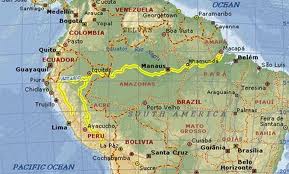
The Amazon rainforest spreads into nine countries:

Brazil, Colombia, Peru, Venezuela, Ecuador, Bolivia, Guyana, Suriname, and French Guiana

The Açaí: Tree, Berry, and Seed

Synonym
Euterpe edulis.
Common name
Cabbage palm, pina palm, asai, palmier pinot, juçara, açai, palmito açai, asaí, manaca, palmiche de rio negro.
Family
Palmae (Aracaceae).
Acaí is a pencil-like palm with drooping pinnate leaves, indigenous to the Amazon rainforest, growing up to a height of 65 feet. There are both male- and female flowers on the same tree and the seeds germinate easy. The diameter of the trunk is no more than 7 - 9 inch. The açaí palm is a fast grower and more of a cespitose palm (palms growing in small dense clumps or tufts) with multiple stems, growing in flooded areas (swamps). The fruits are round berries, purple-black at maturity, and hang in bunches of 700-1,000 with a weight of up to 120 lbs. The harvest period is from July to March.

The pulp is edible and used in beverages. The palm heart of the açaí palm is delicious and exported from Brazil, Suriname and Guyana to countries all over the world. The açaí fruit, which is about the size of a blueberry, contains vitamins and minerals: many of the B vitamins, Vitamin C, Vitamin E, iron, potassium, phosphorus and calcium. It also contains antioxidants and phytochemicals (anthocyanins, proanthocyanidins, resveratrol). It works against cholesterol problems and gives lots of energy. It has a high percentage of dietary fibers.
The health benefits of the açaí fruit made news in the United States since Dr. Perricone included the açaí in his list of one the ten most important superfoods in his appearance in the Oprah show. There is an array of websites selling açaí in the form of juice and capsules in the internet today and a bottle of açaí juice can cost up to $40.00.The following article by CNN refutes the claim that açaí is "the miracle berry:" http://www.cnn.com/2009/HEALTH/03/23/acai.berries.scam/
The açaí seed is very popular in Brazil in the making of jewelry. It is an easy seed to dye and it can be found in all colors. The size of the seed is about 8mm to 10mm and its natural color is ivory. The irregular roundness of the seed is its charm -- a row of açaí seed is not uniform, it has "movement." The small vertical marking found in every seed is another characteristic. For the following necklace I dyed the seeds in different shades of beige and the effect is beautiful:


If you would like to see more necklaces go to www.sporadesign.com

Seeds in the Website


I added a list of the seeds I use the most in my designs to the spora website. I got the information about the seeds from this gorgeous book that has just been published in Brazil: Sementes Ornamentais do Brasil / Ornamental Seeds of Brazil, edited by Francisca Portinari Leåo, published by Reler Editor Ltda, Rio de Janeiro, 2008.

It is very nice to have an "official" guide to the seeds. My experience is that people tend to be very creative when they don't know the name of the seeds they are selling!

Check it out: www.sporadesign.com

Why "Amazon"?


Dying Amazon
by Franz von Stuck,1905
(Harvard University)


The name of the Brazilian rainforest comes from the Amazons of Classical and Greek mythology. The Amazons was a nation of brave female warriors who formed an independent kingdom under the government of a queen. In some versions of the myth, no men were permitted to have sexual encounters or reside in Amazon country; but once a year, in order to prevent their race from dying out, they visited a neighbouring tribe.

As per wikipedia, the name Amazon for the rainforest is said to arise from a war which Francisco de Orellana had with a tribe of Tapuyas and other tribes from South America. The women of the tribe fought alongside the men, as was the custom among the entire tribe. Orellana's descriptions may have been accurate, but a few historians speculate that Orellana could have been mistaking indigenous men wearing "grass skirts" for women.

It is interesting that in this painting the amazon is holding her right breast. Wikipidia:

"One of the versions of the myth tells that the roots for the word amazon is from a-(privative) + mazos, "without breast," connected with a tradition that Amazons had their right breast cut off or burn out, so they would be able to use a bow more freely and throw spears without the physical limitation and obstruction; there is no indication of such a practice in works of art, in which the Amazons are always represented with both breasts, although the right is frequently covered."

In this painting the right breast is not covered and on the contrary, it is emphasized by light and by the fact that the Amazon is holding it.

What can Franz von Stuck be trying to tell us...